I Analyzed a Week of My Life With Transcripts. Here's What I Found
On this page
- 78 hours, 93,890 words, and 5% of them mine
- The mirror: 64% screens, 31% humans, 5% silence
- Where 78 hours went
- The rhythm of the days
- Three moments numbers cannot replace
- What the week held — and what it didn't
- The helper, and why I keep doing this
- What actually changed the next week
- How to run this on your own week
- The privacy part, said plainly
- The bottom line
I did not set out to audit my life. I set out to stop losing it.
For months I had the same conversation with myself on Sunday night: where did the week go? Not in a poetic way — in a genuinely blank way. Seven days had happened. I could recall maybe four scenes. I knew I had worked a lot, and I had a vague, guilty sense that I had not seen my family much, and that vagueness was the worst part. You cannot fix a feeling. You can only fix a fact.
So I did something simple. I kept BlackBox running in the background for a week, let it transcribe everything on-device, and each night the daily transcript export dropped the previous day into a folder as timestamped text. On Saturday I had six plain-text files sitting there — Sunday the 12th through Friday the 17th of July. I handed them to an AI and asked one question: where did my week actually go?
This is the report it gave me back, and what happened to me when I read it.
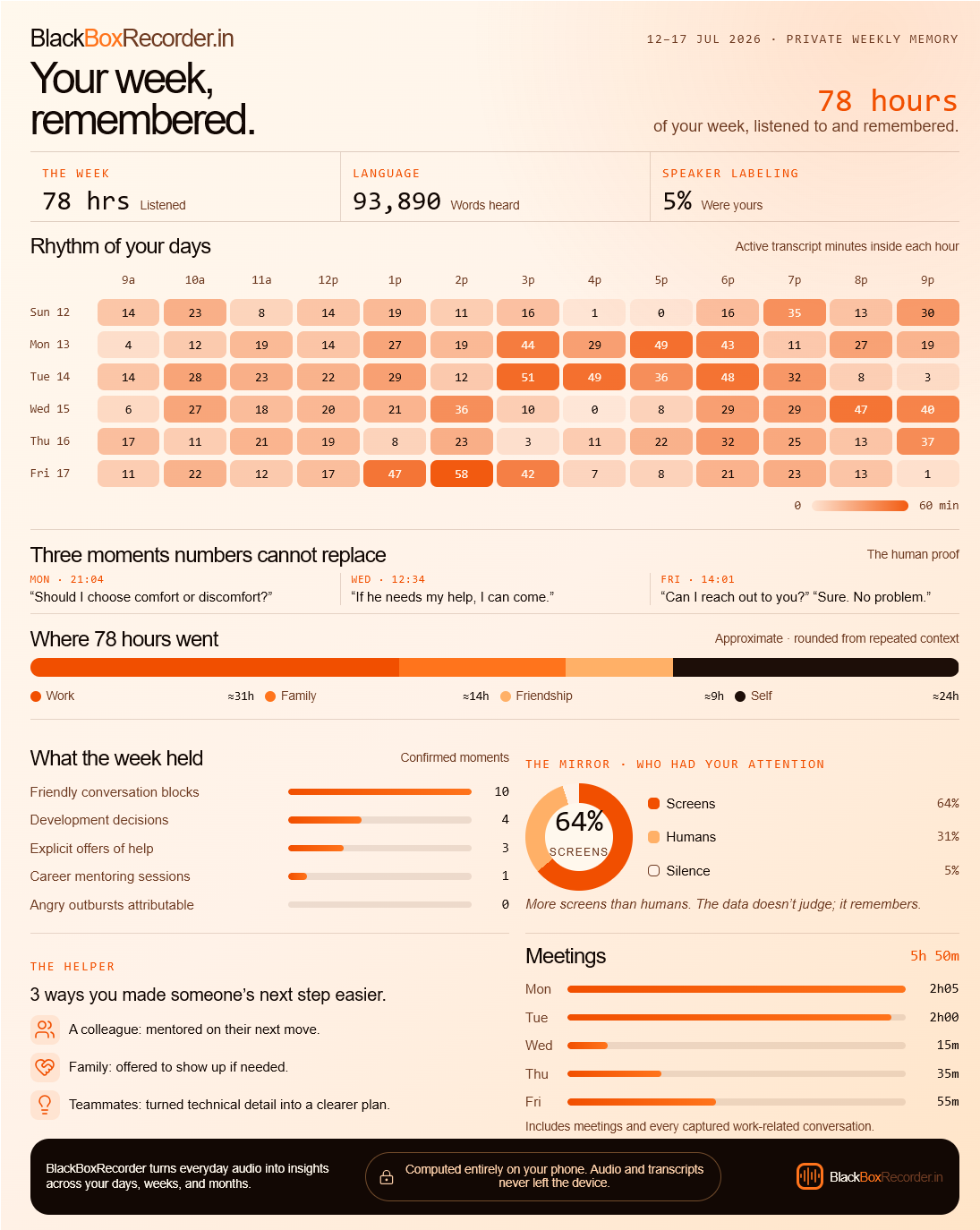
78 hours, 93,890 words, and 5% of them mine
The first three numbers landed before I got to any of the charts.
78 hours listened. That is what the week held once you subtract sleep and the times the phone was in another room. Seventy-eight hours is a number you can hold. It is not "a busy week." It is a budget.
93,890 words heard. For scale, that is a novel. I spent a week inside a novel's worth of language and could quote almost none of it back on Sunday.
5% were yours. That one stopped me. Of every twenty words that passed through my week, one was mine. I had always thought of myself as someone who talks a lot at work. The transcript says I mostly listened, or — more honestly — I was mostly in rooms where something else was talking. Which brings us to the number I did not want.
The mirror: 64% screens, 31% humans, 5% silence
There is a small donut chart in the corner of that report and it is the least flattering thing I have ever generated about myself.
Nearly two-thirds of the audible week was screens. Videos, calls, autoplay, background YouTube, something playing while I cooked. Under a third was actual humans in the room with me. Five percent was silence — and I suspect most of that was me asleep with the phone charging.
The report added one line under the chart, and I have thought about it every day since: "More screens than humans. The data doesn't judge; it remembers."
That is the whole reason this works. A friend telling me I'm on my phone too much triggers a defense. A number I generated myself, from my own week, with no one watching, does not. There is nobody to argue with. I sat with it for a while, and then I went and put my phone in a drawer for the evening — not because I made a resolution, but because I had seen the receipt.
Where 78 hours went
Then the split. Approximate, rounded, honest enough:
| Where | Hours | Share of the week |
|---|---|---|
| Work | ≈31h | 40% |
| Self | ≈24h | 31% |
| Family | ≈14h | 18% |
| Friendship | ≈9h | 11% |
Here is what I would have guessed on Sunday night, before I saw it: work 50, family 5, friends 2, self almost nothing. I was carrying around a story where work was eating me alive and everyone I loved was getting the scraps.
The truth was gentler and more useful. Work took 31 hours of my waking, audible week — a lot, but not the monster in my head. Family got 14 hours. Fourteen. Not the "barely saw them" I'd been telling myself. And "self" — 24 hours of my own time — was not the zero I'd have sworn to. It was the biggest surprise in the report and, weirdly, the most emotional one. I had been feeling deprived of a thing I was actually getting.
That is what data does to guilt. It does not always absolve you. But it replaces a vague ache with a specific, checkable shape, and a specific shape is something you can move.
The rhythm of the days
Above the split is a heatmap — every hour from 9am to 9pm, every day of the week, shaded by how much conversation actually happened inside it. It is the closest thing I have seen to a photograph of my own energy.
You can see the week in it without reading a word:
- Sunday is pale until evening, then a bright block at 7pm and 9pm. That was family time. It shows up as heat.
- Monday and Tuesday afternoons are on fire — 44, 49, 51, 49, 48 minutes of talk inside a single hour, back to back. Those were my two heavy meeting days, and looking at them I understood exactly why I felt hollowed out by Tuesday night.
- Wednesday morning is almost white. Six minutes at 9am. That was deep work, and it was the most productive stretch of my week.
- Friday 1pm to 3pm is the brightest patch on the grid: 47, 58, 42. One long conversation that ran away with the afternoon — and, per the same report, one of the best things that happened all week.
I have read a hundred articles telling me to protect my mornings. None of them landed like seeing my own quiet Wednesday next to my own scorched Tuesday.
Three moments numbers cannot replace
And then, in the middle of the report, three lines pulled straight out of the transcripts. Timestamped. Verbatim. Things actually said in my week:
MON · 21:04 — "Should I choose comfort or discomfort?"
WED · 12:34 — "If he needs my help, I can come."
FRI · 14:01 — "Can I reach out to you?" "Sure. No problem."
I had forgotten all three. Completely. The Monday one was me, late at night, thinking out loud about a decision I am still making. The Wednesday one was about family — an offer I made without thinking, which is the only kind that counts. The Friday one was someone asking me for help and me saying yes.
This is where the analytics stopped being analytics for me. A dashboard tells you how you spent your week. A quote tells you who you were in it. I have a folder of hour counts and category splits, and I would trade the whole folder before I gave up those three lines. They are the part of the week that would have evaporated by Monday, and they are the part that made me feel like a person rather than a workload.
If you take one thing from this post: capture is not about the numbers. The numbers are how you find the moments. See why searchable transcripts change what you can remember.
What the week held — and what it didn't
The report also counted things. Not vague vibes, actual tallies pulled from the words:
- 10 friendly conversation blocks — real, unhurried talk, not transactions.
- 4 development decisions — things I decided rather than deferred.
- 3 explicit offers of help — times I said, out loud, I can do that for you.
- 1 career mentoring session — a colleague, thinking about their next move.
- 0 angry outbursts attributable.
I want to be honest about that last line, because it is the one that got me. Zero.
I have spent years quietly believing I am short-tempered. It is a story I inherited and never checked. And here is a week — 78 hours, 93,890 words, meetings that ran long, a Tuesday that flattened me — with nothing in it. Not one.
No amount of self-reflection would have given me that. Memory does not store absences; it stores the two times you snapped in 2019 and replays them forever. Only a complete record can tell you what didn't happen. That is a kind of relief you cannot reason your way into.
The helper, and why I keep doing this
At the bottom, the report did something I did not ask for. It counted the ways I had made someone else's next step easier that week: mentored a colleague on their next move, offered to show up for family if needed, turned technical detail into a clearer plan for teammates.
Three small things. All forgotten by Friday. None of them would have made it into a journal entry, because on the day they happened they did not feel like anything.
That is the quiet thing I did not expect from lifelogging: it is not primarily a productivity tool. It is a corrective for the fact that human memory is biased toward what went wrong. My week remembered my failures for me for free. It took a transcript to remember the good.
What actually changed the next week
Analytics you don't act on are a hobby. Here is what the report changed, concretely:
- I moved one recurring meeting off Tuesday afternoon. The heatmap made the pile-up impossible to unsee — two days carrying nearly all the meeting load while Wednesday sat empty.
- I stopped background video while cooking. Not a purity thing. Just: 64% screens was too high a share of a finite week, and dinner was the cheapest hour to buy back.
- I protected Wednesday mornings. They were already my quietest, sharpest hours. The data just gave me permission to defend them.
- I stopped feeling guilty about family time and started scheduling it. Fourteen hours is not failure. Fourteen hours is a baseline I can now watch move up or down instead of guessing about.
- I saved the three quotes. They live in a file now. When a week feels pointless, I read them.
Five weeks in, the only one that required willpower was the second. The rest were just schedule changes I could finally justify, because I had evidence instead of a hunch.
How to run this on your own week
The whole loop takes about ten minutes to set up once, and roughly five minutes a week after that.
- Record the week, not the highlights. Start always-on recording in the morning and forget about it. It runs with the screen off and without wrecking your battery. You will not know in advance which Friday afternoon becomes the best hour of the week.
- Download the on-device transcription model. Settings → Transcription model → Download. This is what makes the whole thing defensible: your week becomes text on your own hardware, with no upload and no account.
- Turn on Daily transcript export. Settings → Daily transcript export → pick a folder. Each night, while your phone charges, yesterday gets written out as timestamped text. By Saturday you have seven files and you did nothing to earn them.
- Ask one question on Sunday. Hand the week's transcripts to an AI and ask: "Read these seven timestamped transcripts. Where did my week go — roughly how many hours on work, family, friendship and time alone? Show my week as an hour-by-hour heatmap of conversation density. Count how many times I offered help, made a decision, or lost my temper. Then pull three quoted moments a summary would miss, with timestamps."
- Change exactly one thing. Not five. One. Then run it again next week and see whether the number moved.
That prompt is the entire analysis engine. Everything in the report above came from a version of it. For the day-level version of this loop, see reviewing your day with AI transcripts; for the habit that makes it stick, see the daily audio review.
The privacy part, said plainly
A written, queryable record of your week is powerful, which is exactly why the architecture matters more than the features.
- Capture and transcription happen on your phone. BlackBox needs no account and uploads nothing to turn audio into text. It works offline.
- You own the file. The nightly export writes to your folder. Nothing is shared automatically, ever.
- The library is locked behind Face ID.
- The AI step is the one door out, and you hold it. Run a local model over the folder for full privacy, or redact names before pasting into a cloud assistant — an AI can still tell you where your week went when "Alex" is "a friend."
The rule I keep: a record of your life is only a good idea if it stays yours. On-device capture plus a transcript you control is what makes weekly life analytics feel like a mirror instead of surveillance.
The bottom line
I used to end the week with a feeling. Now I end it with a page.
Seventy-eight hours. Thirty-one at work, fourteen with family, nine with friends, twenty-four with myself. Sixty-four percent screens. Ten good conversations. Three times I offered to help someone. Zero times I lost my temper. Three sentences I said out loud and would otherwise have lost forever.
None of that came from a tracker I had to feed, a journal I had to keep, or a discipline I had to sustain. It came from leaving a recorder on, letting it transcribe on-device, and asking one honest question at the end of the week.
You cannot improve a week you cannot see. BlackBox records your days in the background, transcribes them privately on your phone, and hands you yesterday as clean text every morning — free on iOS and Android, with everything kept on your device. Turn it on tonight. Ask the question on Sunday. Whatever the report says about you, at least it will be true.
Frequently asked questions
How do I analyze my week with recordings?
Record your days with an always-on recorder, let BlackBox transcribe them on-device and auto-export a timestamped transcript each night, then hand the week's seven transcripts to an AI and ask it where your time went. Because the transcripts carry timestamps, the AI can break the week into hours, categories and themes instead of guessing.
Can transcripts really show how much time I spend with family?
Approximately, yes — and approximately is enough to be useful. An AI reading a week of timestamped transcripts can tell which stretches were work conversation, which were family, which were friends and which were you alone, then total them. It won't be accurate to the minute, but the ratio between 31 hours of work and 14 hours of family is unmistakable.
Is this private? I don't want my week on someone's server.
BlackBox records and transcribes entirely on-device — no account, no upload, works offline, library locked behind Face ID. You own the exported transcript file, so the only moment anything could leave your phone is the optional AI step, which you control. Use a local model for full privacy, or redact names before pasting into a cloud assistant.
Isn't tracking your life like this obsessive?
It's the opposite of obsessive if you set it up once and look at it weekly. You don't listen back to anything, you don't log anything by hand, and you don't stare at a dashboard all day. You live normally, the recorder runs in the background, and on Sunday you read one page about the week you just had.
Always-on, on-device and private. Free on iPhone and Android.